|
Xin Ding (丁鑫) I am a PhD student at the University of Science and Technology of China (USTC), School of Information Science and Technology, expected to graduate in 2027. I am currently a research intern at Microsoft Research Asia. Previously, I interned at Huawei Noah's Ark Lab, where I was awarded the Huawei Innovation Pioneer (Top 2% of Central Research Institute, the only intern recipient). My research focuses on multimodal large language models, and embodied agents. I have published papers in top international conferences in artificial intelligence and computer vision, including ICCV, CVPR, ECCV, ICLR, and ICML, and received the 2025 ICLR Spotlight. I have received the National Scholarship (Top 1%), the Huawei 2012 Star, and the Microsoft Star of Tomorrow. |
|
🔥 News & Highlights |
|
🏆 Zeva-Ego: Egocentric Mid-Training with In-Context Causal Learning Learning scalable physical priors from human egocentric experience, then continuously improving through robot interaction—without parameter updates. 📄 arXiv | 🌐 Project Page 🏆 Zetta (ζ): Closed-Loop Physical Intelligence with Online Learning Our latest work on embodied AI achieves groundbreaking "Aha Moment" for robots through closed-loop online learning! 📰 Featured on 机器之心 front page | 🤗 #1 on Hugging Face Daily Papers | ⭐ 1K+ GitHub stars in three weeks | 📄 arXiv |
Demos |
|
🔥 Zetta (ζ) — Closed-loop physical intelligence with online learning |
|
🔥 Zeva — In-context causal learning for generalizable embodied manipulation |
|
StreamMind — Full frame rate streaming video dialogue |
|
Em-Garde — Proactive streaming video understanding |
|
AdaNav — Adaptive reasoning for vision-language navigation |
ResearchI am currently interested in the continual self-evolution of embodied agents, including high-level planning, memory management and low-level World-Action Models (WAMs). |
Embodiment |
|
|
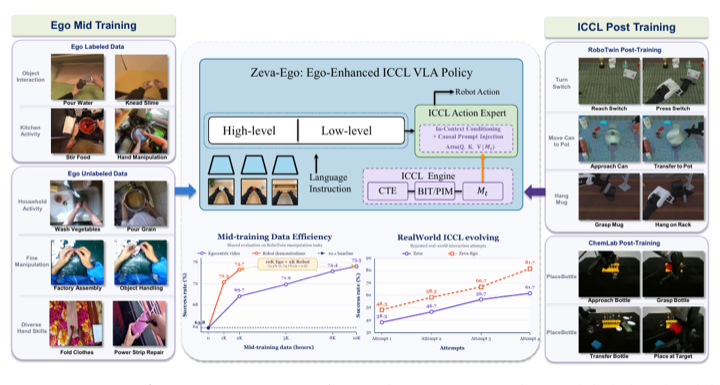
🔥 Zeva-Ego: Egocentric Mid-Training with In-Context Causal Learning for Robot Manipulation
Bingjia Huang*, Xin Ding*†, Fu Chen*, Kun Li, Wei Sun, Hao Wu‡, Yunxin Liu, Ting Cao† Preprint, 2026 (NEW! Co-First Author & Corresponding Author) arXiv / Project Page Zeva-Ego learns action-centered physical priors from labeled and unlabeled egocentric video, then uses ICCL to adapt from robot action-effect feedback with frozen parameters. Scaling to 10K hours of Ego video improves RoboTwin success from 63.8% to 75.3%, while accumulated interaction experience raises success from 58% to 89% within four attempts. |
|
|
🔥 Zetta (ζ): Closed-Loop Physical Intelligence with Online Learning
Xin Ding, Liang Mi, Mingzhe Huang, Zixuan Wang, Chao Zhang, Zixu Hao, Fu Chen, Xiangyu Li, Yikai Zheng, Yaoyu Guo, Weijun Wang, Kun Li, Hao Wu, Yunxin Liu, Ting Cao Preprint, 2026 (NEW! First Author & Tech Lead, Featured on 机器之心 & HuggingFace Daily Papers #1) arXiv / 机器之心 News / 🤗 HuggingFace A breakthrough in embodied AI that enables robots to experience "Aha Moment" through closed-loop online learning. Zetta achieves self-evolving physical intelligence by continuously learning from interaction with the environment, demonstrating unprecedented adaptability and problem-solving capabilities in real-world robotic tasks. |
|
|
🔥 Zeva: In-Context Causal Learning for Generalizable Embodied Manipulation
Fu Chen*, Xin Ding*, Bingjia Huang, Xiangyu Li, Mingju Wang, Jiawei He, Kun Li, Wei Sun, Yunxin Liu, Hao Wu†,‡, Ting Cao†,§ Preprint, 2026 (NEW! Co-First Author & Tech Lead, Featured on 量子位) arXiv / 量子位 News / Project Page An In-Context Causal Learning World-Action Model (WAM) that enables robots to learn the causal impact of their actions on the environment from past interactions and apply this knowledge to future tasks. Zeva learns how to complete tasks from human demonstrations or self-exploration without training, extracting causality between actions and state changes on-the-fly during execution. Achieves 83.3% success on real-world manipulation and demonstrates strong success-rate scaling from 57% to 90% across self-evolution iterations, with robust cross-task generalization. |
|
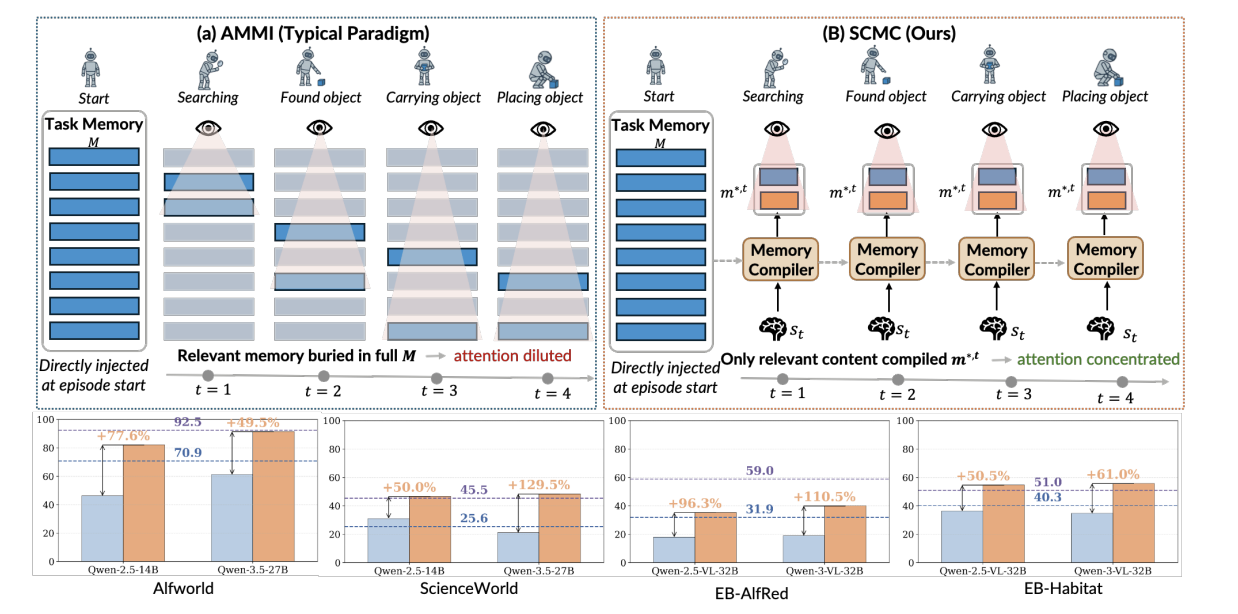
MemCompiler: Compile, Don't Inject — State-Conditioned Memory for Embodied Agents
Xin Ding, Xinrui Wang, Yifan Yang, Hao Wu, Shiqi Jiang, Qianxi Zhang, Liang Mi, Hanxin Zhu, Kun Li, Yunxin Liu, Zhibo Chen, Ting Cao NeurIPS, 2026 (Review, Co-First Author) arXiv / News A state-conditioned memory compilation framework that dynamically selects and compiles relevant memories based on the agent’s current execution state into guidance. It improves over no-memory baselines across Qwen backbones (up to +129%), matches or approaches frontier closed-source systems(GPT and Gemini), and reduces latency by up to 60%.. |
|
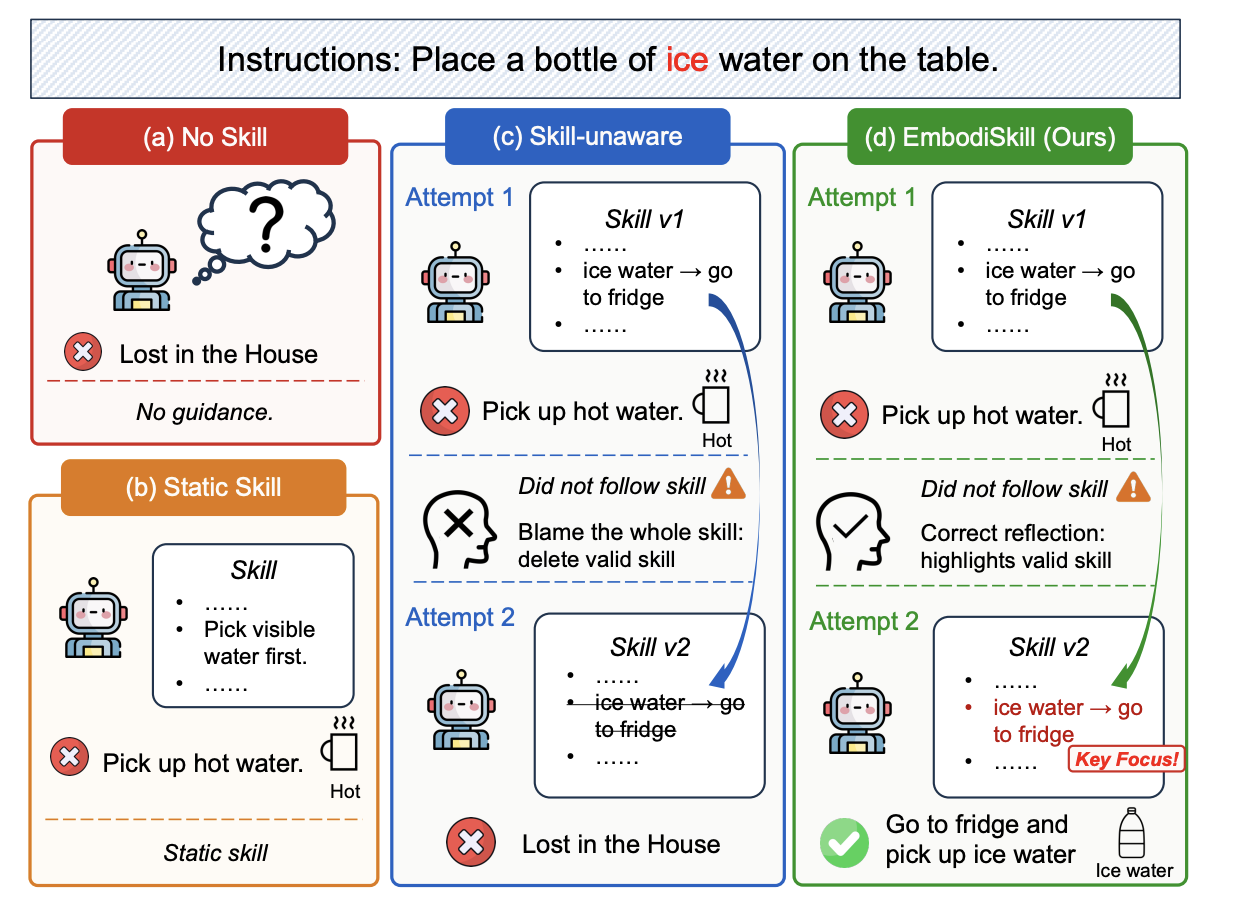
EmbodiSkill: Skill-Aware Reflection for Self-Evolving Embodied Agents
Ruofei Ju, Xinrui Wang, Xin Ding, Yifan Yang, Hao Wu, Shiqi Jiang, Qianxi Zhang, Hao Wen, Xiangyu Li, Weijun Wang, Kun Li, Yunxin Liu, Haipeng Dai, Wei Wang, Ting Cao. NeurIPS, 2026 (Review, Corresponding author) arXiv / News A training-free framework for embodied skill self-evolution that performs skill-aware reflection over trajectories to distinguish skill errors from execution lapses and selectively revise skill content. It consistently improves embodied task success on ALFWorld and EmbodiedBench, enabling a frozen Qwen3.5-27B executor to reach 93.28% success on ALFWorld and outperform GPT-5.2 as a direct agent by 31.58%. |
|
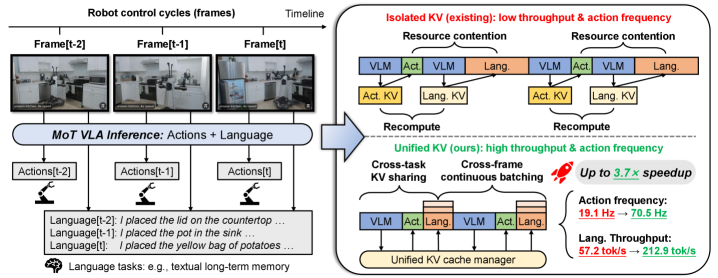
OxyGen: Unified KV Cache Management for Vision-Language-Action Models under Multi-Task Parallelism
Xiangyu Li, Huaizhi Tang, Xin Ding, Weijun Wang, Ting Cao, Yunxin Liu. Neurips, 2026 (Under Review) arXiv A unified KV-cache management framework for MoT-based vision-language-action models that enables cross-task KV sharing and cross-frame continuous batching for efficient parallel inference. It achieves up to 3.7× speedup while supporting simultaneous high-throughput language generation and real-time action control without performance degradation, validated on both NVIDIA 4090, Jetson AGX Thor, and a real humanoid robot.. |
|
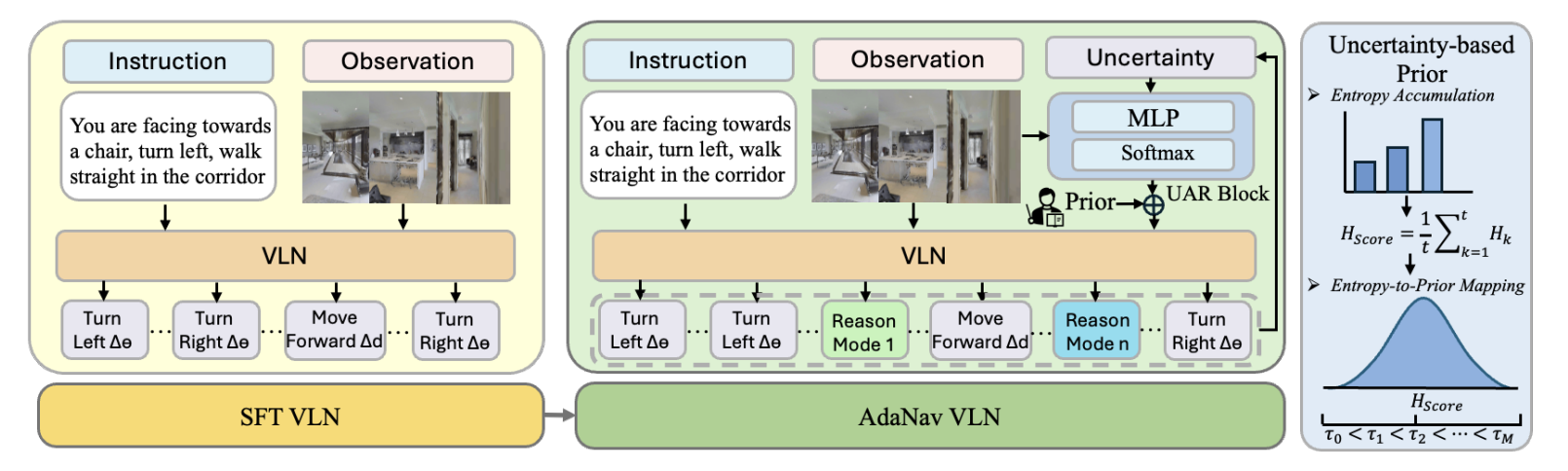
AdaNav: Adaptive Reasoning with Uncertainty for Vision-Language Navigation
Xin Ding, Jianyu Wei, Yifan Yang, Shiqi Jiang, Qianxi Zhang, Hao Wu, Fucheng Jia, Liang Mi, Yuxuan Yan, Weijun Wang, Yunxin Liu, Zhibo Chen, Ting Cao . ICML, 2026 (First Author) arXiv / News A uncertainty-based adaptive reasoning for VLN agents via UAR Block and a heuristic-to-RL training curriculum. Achieves 3× reasoning cost reduction and surpasses closed-source models trained on millions of samples using only 6K training examples. |
|
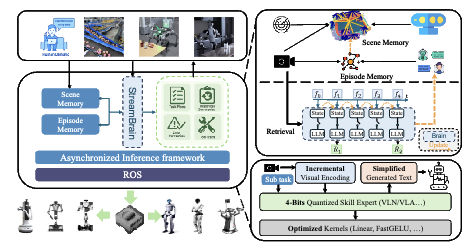
EdgeMind-OS: A Plug-and-Play Embodied Intelligence System for Real-Time On-Device Deployment
Xin Ding, Jianyu Wei, Fucheng Jia, Liang Mi, Ruofei Ju, Xianye Wang, Yikai Zheng, Ziming Zhang, Weijun Wang, Shiqi Jiang, Yunxin Liu, Ting Cao. MobiCom, 2025 Demo (First Author) ACM DL A fully on-device embodied intelligence system with a hierarchical architecture integrating a real-time StreamBrain, modular skill experts, and dynamic scene-episode memory for low-latency, privacy-preserving interaction. It achieves up to 7.3× faster local processing and enables real-time embodied tasks such as navigation, memory recall, and multimodal interaction on a mobile robot without relying on cloud infrastructure. |
Multimodal Large Language Models |
|
|
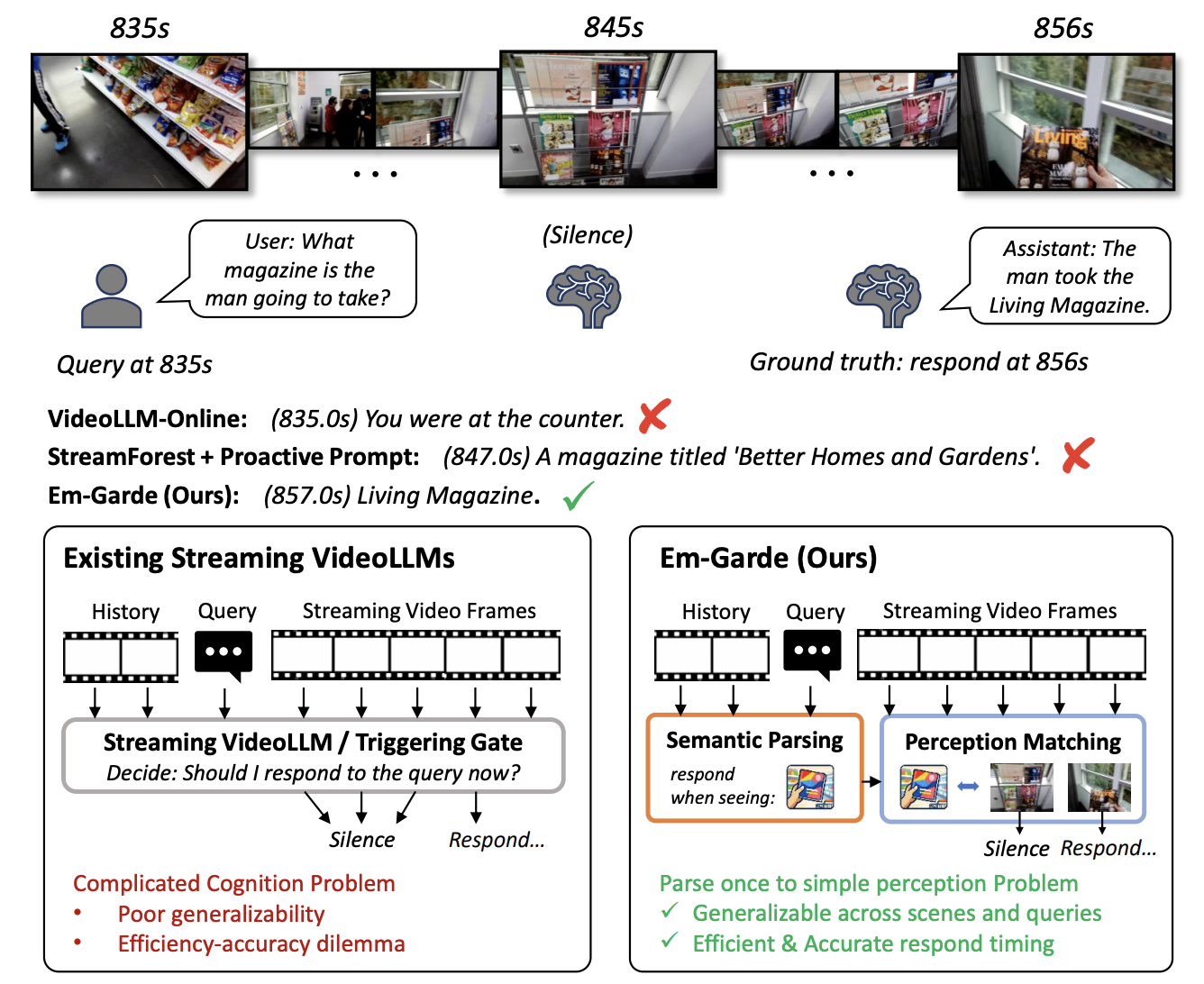
Em-Garde: A Propose-Match Framework for Proactive Streaming Video Understanding
Yikai Zheng, Xin Ding, Yifan Yang, Shiqi Jiang, Hao Wu, Qianxi Zhang, Weijun Wang, Ting Cao, Yunxin Liu. ECCV, 2026 (Co-First Author) arXiv / TsingHua University Official News / Twitter A streaming video understanding framework that dcouples semantic parsing from streaming perception; achieves 13fps real-time inference with F1 improvement of 10%+ on StreamingBench and OVO-Bench over existing Streaming VideoLLMs. |
|
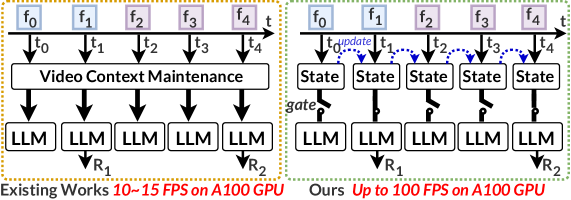
StreamMind: Unlocking Full Frame Rate Streaming Video Dialogue through Event-Gated Cognition
Xin Ding, Hao Wu, Yifan Yang, Shiqi Jiang, Donglin Bai, Zhibo Chen, Ting Cao. ICCV, 2025 (First Author) arXiv/ Microsoft Official News Decouples perception and cognition via Event-Perception Feature Extractor (EPFE) and cognition gate, breaking the 100fps high-frame-rate video processing bottleneck. Achieves SOTA on multiple benchmarks; deployed in Microsoft Xbox game engine and Asiainfo anomaly detection. |
Model Compression |
|
|
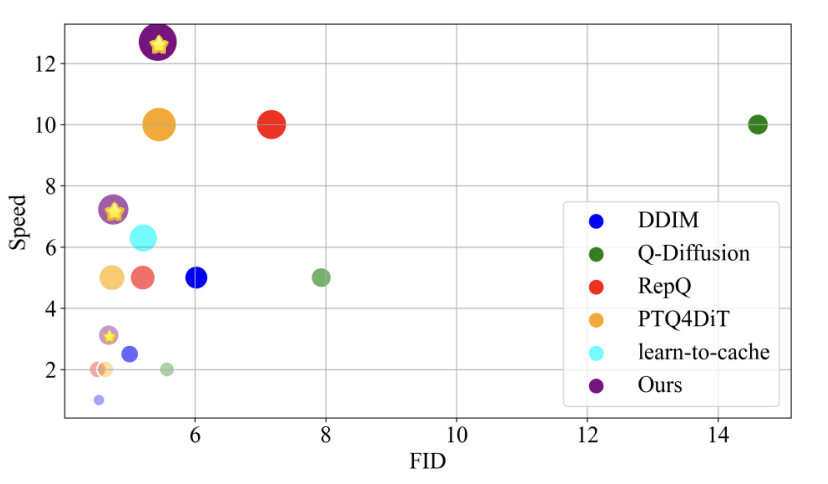
Q&C: When Quantization Meets Cache in Efficient Image Generation
Xin Ding, Xin Li, Haotong Qin, Zhibo Chen. ICLR, 2026 (First Author) arXiv Joint optimization of quantization and KV cache for efficient image generation. Achieves W4A4 quantization with accuracy drop within 2%–9% and FP16-level quality at W8A8. |
|
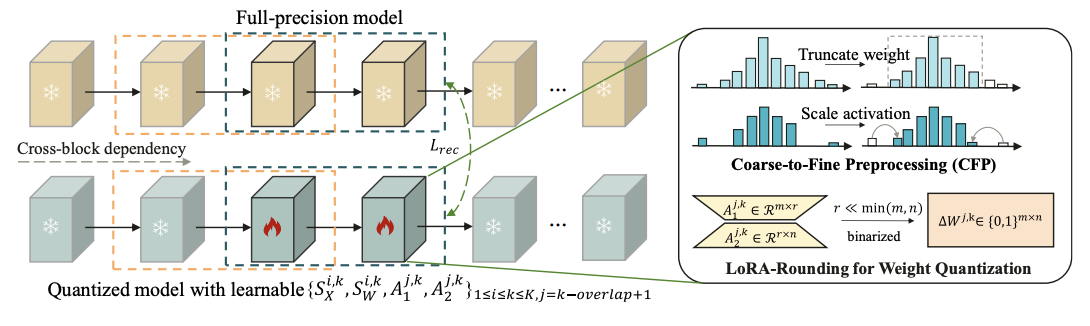
CBQ: Cross-Block Quantization for Large Language Models
Xin Ding, Xiaoyu Liu, Zhijun Tu, Yun Zhang, Wei Li, Jie Hu, Hanting Chen, Yehui Tang, Zhiwei Xiong, Baoqun Yin, Yunhe Wang. ICLR, 2025 Spotlight (First Author) arXiv / News Cross-block dependency reconstruction for post-training quantization of LLMs. First to achieve W4A4 ultra-low-bit quantization of large models; accuracy gap within 1% of FP16 at W4A16 and W8A8. Deployed in Huawei Pangu and other production LLM acceleration projects. |
|
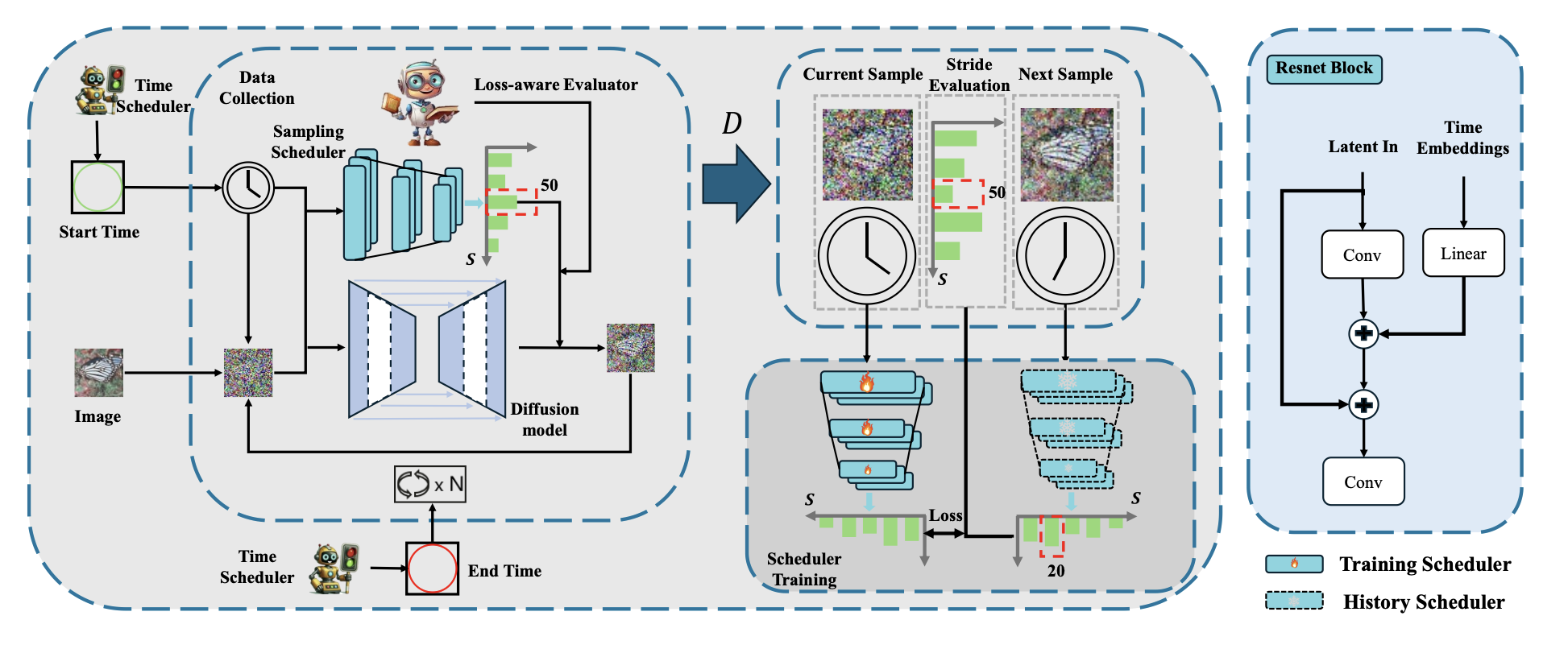
RaSS: Improving Denoising Diffusion Samplers with Reinforced Active Sampling Scheduler
Xin Ding, Lei Yu, Xin Li, Zhijun Tu, Hanting Chen, Jie Hu, Zhibo Chen. CVPR, 2025 (First Author) paper Reinforcement learning-based active sampling scheduler for denoising diffusion models, improving sample quality and efficiency. |
|
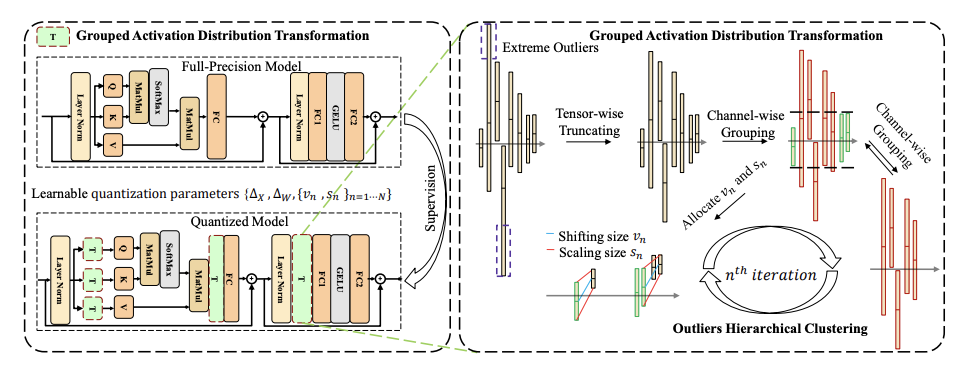
PQ-SAM: Post-Training Quantization for Segment Anything Model
Xiaoyu Liu, Xin Ding, Lei Yu, Yuanyuan Xi, Wei Li, Zhijun Tu, Jie Hu, Hanting Chen, Baoqun Yin, and Zhiwei Xiong ECCV, 2024 (Co-First Author) paper First quantization algorithm for SAM. Gradient-based feature redistribution and joint quantization step optimization. Achieves lossless quantization at W8A8 (accuracy gap <1% vs FP32); deployed in Huawei HiSilicon on-device deployment. |
|
Template from Jon Barron. |